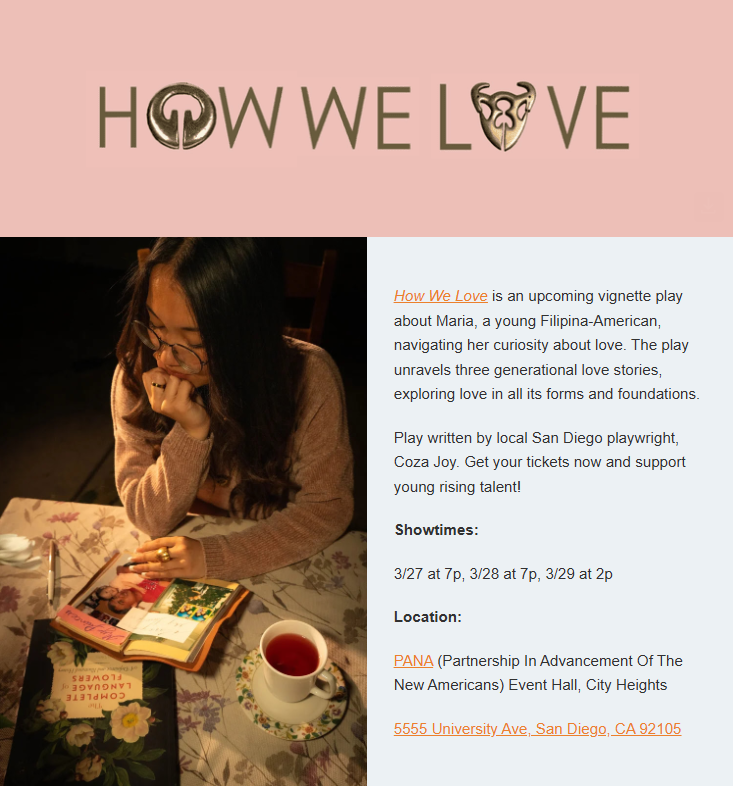
“Have You Eaten?” Exploring the language of love in AAPI households.
In How We Love, playwright Coza Joy "CJ", explores the diverse forms love takes — especially the ones we don’t always know how to name.
There are some families where “I love you” is said frequently.
And there are others where love is understood, but rarely spoken aloud — where it shows up instead as a full plate of food, a reminder to “stay safe,” or a song belted just a little too loudly at a family party.
For many AAPI households, love is built into gestures, rituals, and habits, sometimes stubbornly, unconditionally, and insistently delivered. It becomes a language of its own. In playwright Coza Joy’s debut vignette play How We Love, that unspoken language takes center stage.
The production follows Maria Love Reyes, a young Filipina American navigating her curiosity and observations around love through three intergenerational stories inspired by Coza’s own experiences. But beneath the romance and giddiness is a deeper exploration: not just what love is, but how we learn to recognize it in its many forms.
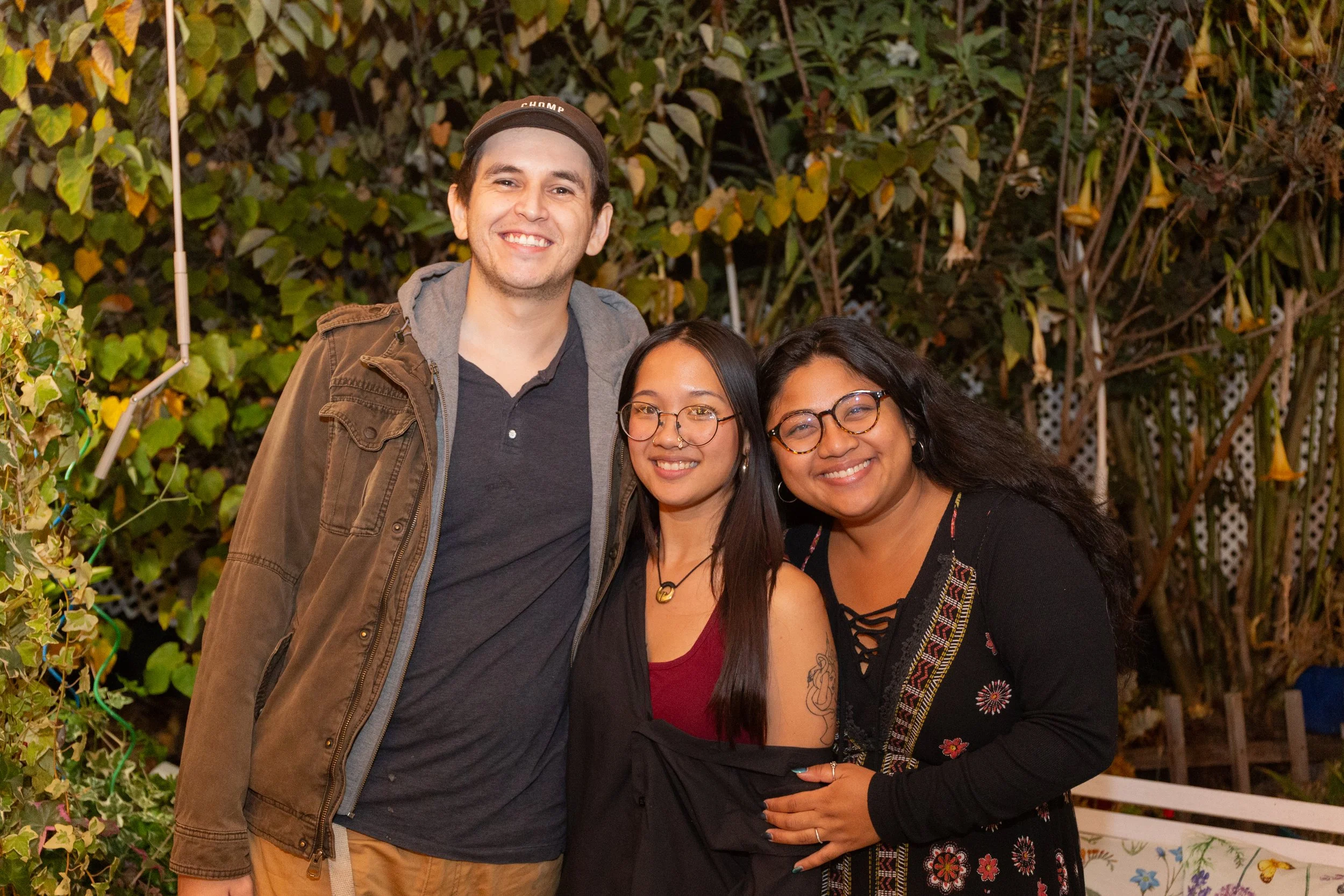
From left to right: Jonny Michel (Stage Manager), Coza Joy (Playwright, Producer & Actress for Maria Reyes), and Bianca Nialani (Director)
Photo courtesy of Christian Hocson
The many forms love can take
“I realized how much I love being in community,” Coza shared. “A lot of the motivation [for How We Love] has just been family parties…karaoke, saying ‘stay safe’ before we leave, the conversations we have about love.”
In How We Love, love is not confined to romance. It includes familial care, friendship, community, and personal growth. It exists in the space between generations — shaped by tradition, but constantly evolving. This is something many AAPI women may recognize intuitively. Growing up, we are often surrounded by love that doesn’t announce itself, but is deeply felt.
Coza points to acts of service as one of the most recognizable expressions of love in Filipino culture. “They will make sure you eat,” she explains. “They’ll bring you a plate, ask you repeatedly if you’ve eaten… it’s a core part of our culture.”
And it doesn’t stop with close family. Love is extended through the community. “There would be people I didn’t know, but they’d still be introduced as my kuya or my cousin,” she says. “We consider friends and people you bring to parties as loved ones, regardless.”
Love, in this sense, is expansive, not limited by bloodlines or labels. It is something you practice in your day-to-day life.
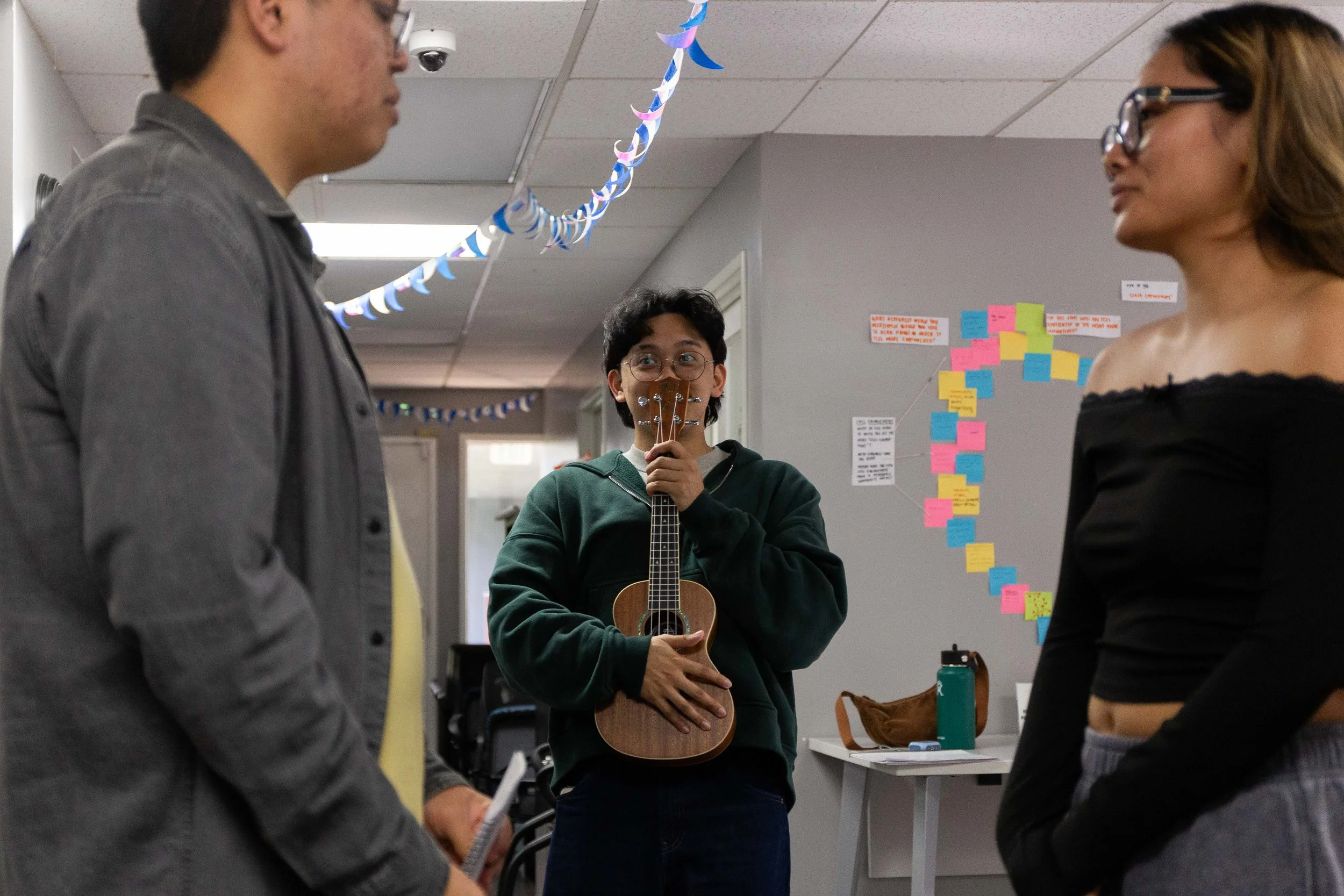
How We Love Rehearsal
Photo courtesy of Christian Hocson
Love evolves through generations
Music plays an important role in the play, inspired in part by harana, a traditional Filipino courtship practice where someone would serenade the person they love. While the traditional version involves singing outside someone’s window, Coza reimagines it through a modern lens.
“It’s not always literally like that anymore,” she explains. “It can be making a playlist, or hearing a song and thinking of someone. Music can be a love language, and I think that’s really beautiful.”
That shift feels especially relevant for younger generations navigating modern relationships. In a world shaped by dating apps and fast communication, the idea of intentional, expressive love can feel both unfamiliar and deeply desired.
Through music and storytelling, How We Love creates space for these different expressions of love to shine through in ways both rooted in tradition and reinterpreted for the present.
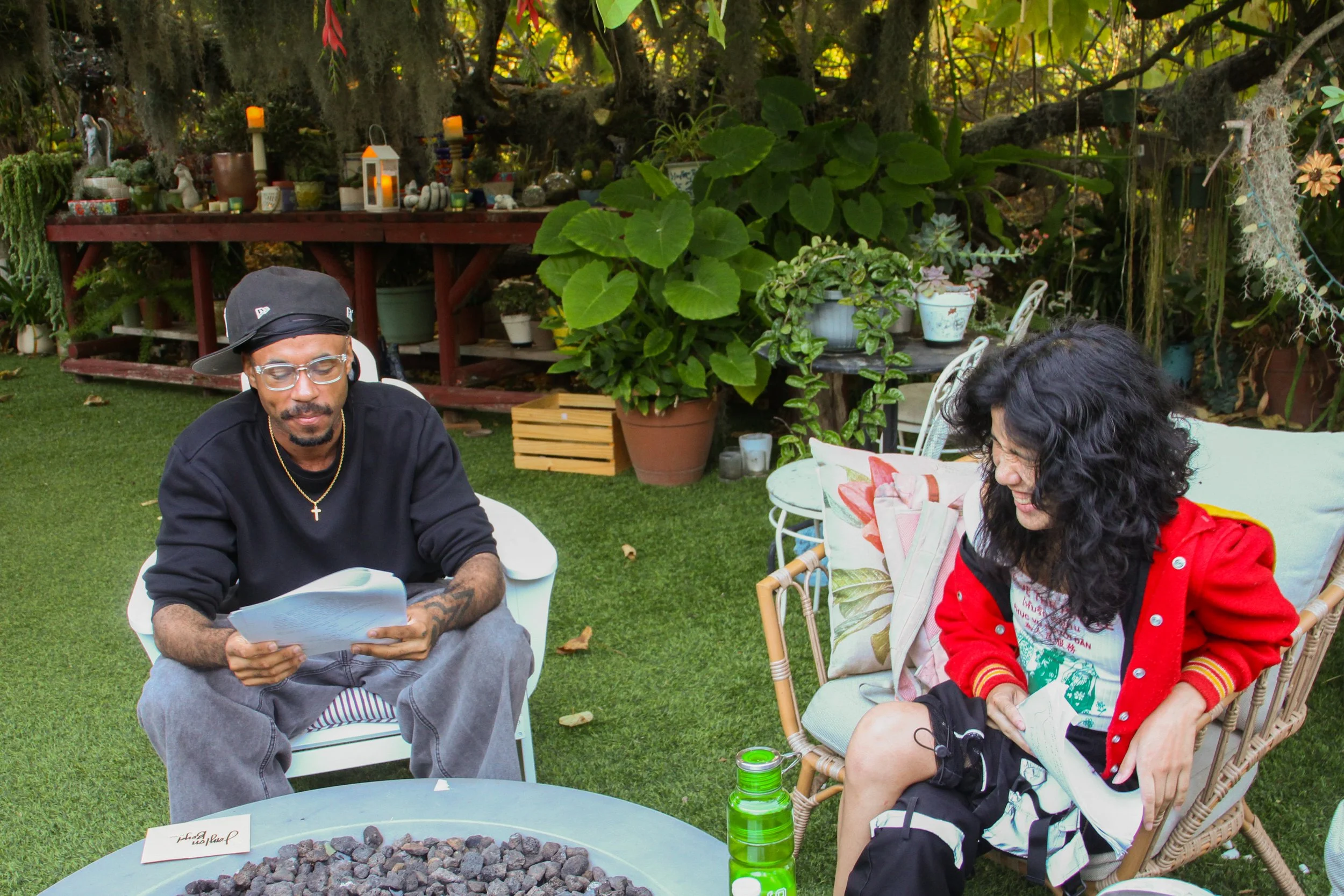
Photo courtesy of Christian Hocson
What we inherit — and what we question
Because the play unfolds across generations, it also reveals how ideas about love are passed down, challenged, and reshaped over time. Some of these inheritances are complex.
Coza shares one example from her own family: a story where a grandmother’s disapproval of a relationship was tied to colorism. While difficult to portray in a short vignette, she chose to focus on a universal theme: the instinct to protect.
“It took a long time to realize that her strictness was coming from a place of protection,” Coza explains. “Like, ‘don’t fall in love too young,’ or ‘don’t get married too early.’” That tension between control and care is one many AAPI families navigate, even in different forms today. What may be read as restrictive can, over time, be reinterpreted as an expression of love and concern shaped by a different world.
At the same time, younger generations are questioning and redefining those patterns, asking, “What do I keep? What do I let go of? What does love look like on my own terms?”
The courage to love authentically
For Coza, writing How We Love was not just an act of storytelling — it was an act of vulnerability and authenticity. “There were times when I was scared to put certain things in,” she admits. “But my friends would tell me, ‘No, you should keep that!’”
As the script evolved, so did her own understanding of love. What began as observation became introspection, ultimately allowing herself to be more honest about what she feels.She was pushed to confront some of her deeper, personal thoughts about love. “I would joke about hating couples, especially when I was single,” she says. “I started asking myself why I said these things.”
That kind of self-reflection is not always easy. But it is often where growth begins.
In How We Love, that honesty is what allows the story to resonate. It does not present love as purely idealistic or purely painful. Instead, it brings both to the audience — the giddy excitement, and the real, sometimes uncomfortable truths that come with it.
To truly understand love, we have to be willing to examine our own experiences of it.
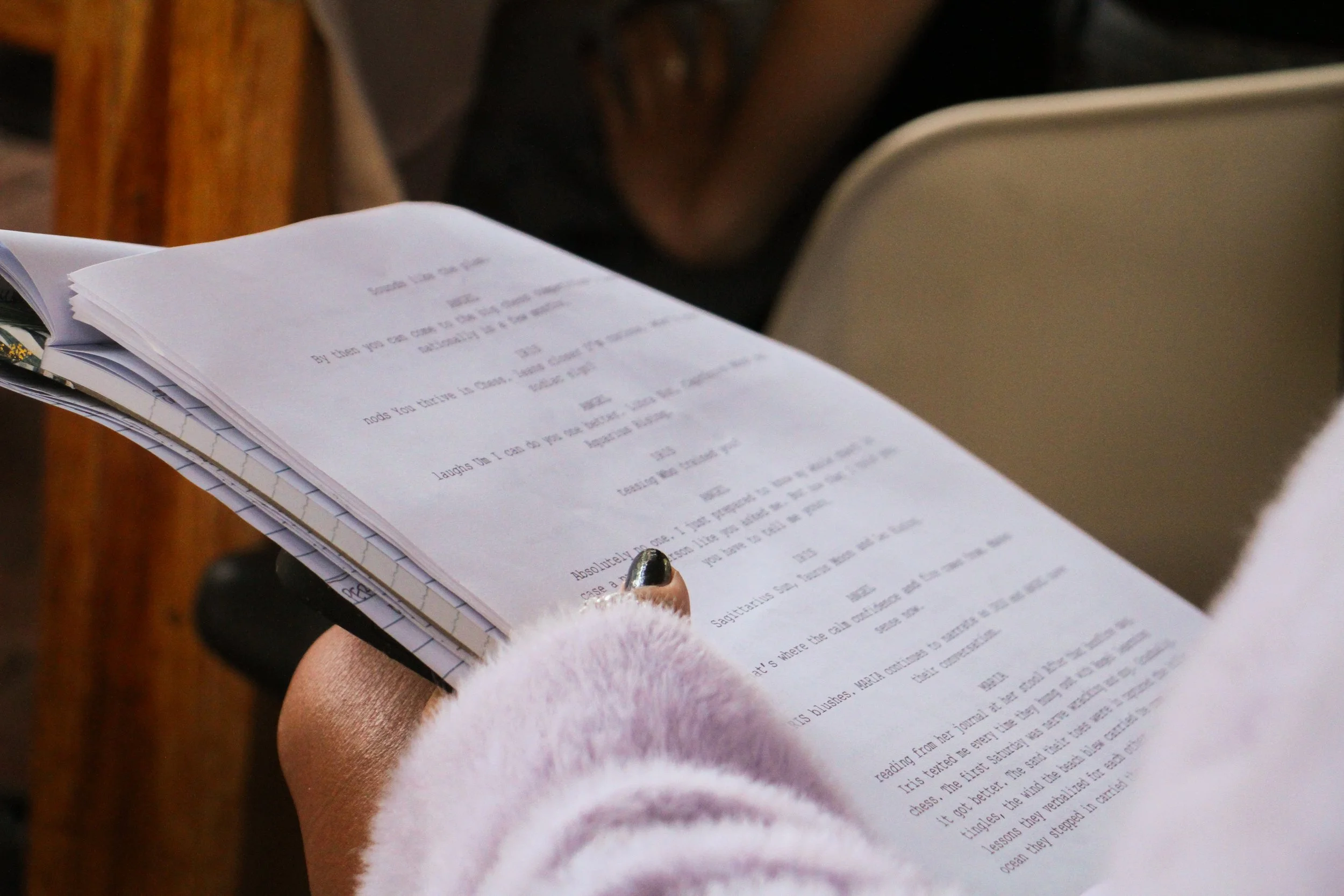
Photo courtesy of Christian Hocson
Expanding our love vocabulary
At its core, How We Love is not just about love itself. It is about learning how to recognize it — especially when it doesn’t look the way we expect.
For many of us, that learning process can take time. It may mean unlearning narrow definitions of romance or recontextualizing childhood memories. It may mean allowing ourselves to express affection more openly than we were taught.
But maybe the goal is not to replace one language of love with another, but to expand our vocabulary.
To recognize that love can be spoken through food, music, presence, persistence. That it can be quiet or loud, awkward or fun, inherited or chosen.
And that, in all its various forms, it is still love.
Reflect
How does love show up in your life? What are the ways your family/friends/partners show love, even if they don’t say it out loud? Share in the comments!