

Eldest Daughter Voices: Kai
The women of Lotus Magazine are no strangers to the impact of ‘Eldest Daughter Syndrome’ on AAPI families. In this piece, three staff writers and editors share their distinct perspectives, capturing the double-edged nature of being the eldest daughter in immigrant households. While each story is deeply personal, their experiences may resonate with you as well, sparking healing and helping you define boundaries that honor your own well-being.
When I tell people that I have a 12- and 16-year age gap between my younger half-brothers, the most common reaction is shock. The age gap may be alarming for some, but it is not uncommon for children of teen parents whose families are broken by divorce.
I was about 11 years old when my mother and step-father told me at Outback Steakhouse that I was going to be an older sister. The appetite I had walking into the restaurant was depleted instantly; my heart fell into the pit of my stomach, filling the emptiness the 6-ounce filet mignon I ordered was supposed to fill.
“Oh my God,” I said, slamming my arms down onto the table as I buried my head into them, dread flooding my veins like lead.
From an outsider’s perspective, it could be perceived that I didn’t want a younger sibling. While this was, admittedly, a very small portion of my reaction at the time, my despair did not come from realizing I would no longer be an only child.
It came from the deep-seated distrust I had of the parental figures and guardians that would take care of my soon-to-be sibling(s).
I was born to two college-aged freshmen who moved to Hawaiʻi from the island of Saipan, one of the 14 islands in the Commonwealth of the Northern Mariana Islands. Having parents who were also university students balancing education and work meant that I was unable to spend as much time with them as I would have wanted.
As an adult looking back, I acknowledge that my caretakers did the best they could do with what they had. That said, there were moments I felt neglected and unable to express my sadness without being reprimanded. When I would cry about how I couldn’t see my Mom or Dad because they were in class or at work, my caretakers would tell me to “be grateful” that my parents were “doing this for me.” Whenever I would express negative emotions, I was told that I “shouldn’t feel that way.”
Making sense of consistent invalidation without being given the tools to self-regulate and explore my emotions in a healthy way led me to seek survival and attention in a different way: overachieving. Getting high marks and awards was the only sure way I could receive the loving attention I sought out so desperately from my caretakers. This overachievement was also fueled by a sense of guilt. One specific set of grandparents was not happy that my Mother got pregnant so young, and I felt that this unhappiness was my fault. If I did “good,” maybe they wouldn’t be upset with me anymore. Maybe they could love me instead.
In the process of doing this, I became conditioned to anticipate what my caretakers needed and what to do or say to avoid them getting upset with me. If I was a “good girl,” everything would be OK, right? So what if I placed myself on the back burner? If the adults around me were happy, that’s all that mattered, right?
Despite what I thought were my best efforts, the love and emotional safety I sought out were never fully given to me by my caretakers.
My biological parents went on to earn Master’s Degrees and get married. I thought, “Finally! I have to spend more time with them now.” You could imagine the devastation I felt when they divorced two years later.
Even when I was blaming myself for my parents’ divorce, I did not confide in my caretakers about my feelings, out of fear of being invalidated again. I continued doing what I did best: overachieving as a means to keep myself from spiraling over the fact that despite being a “good girl,” I still did not feel supported by those who were supposed to take care of me.
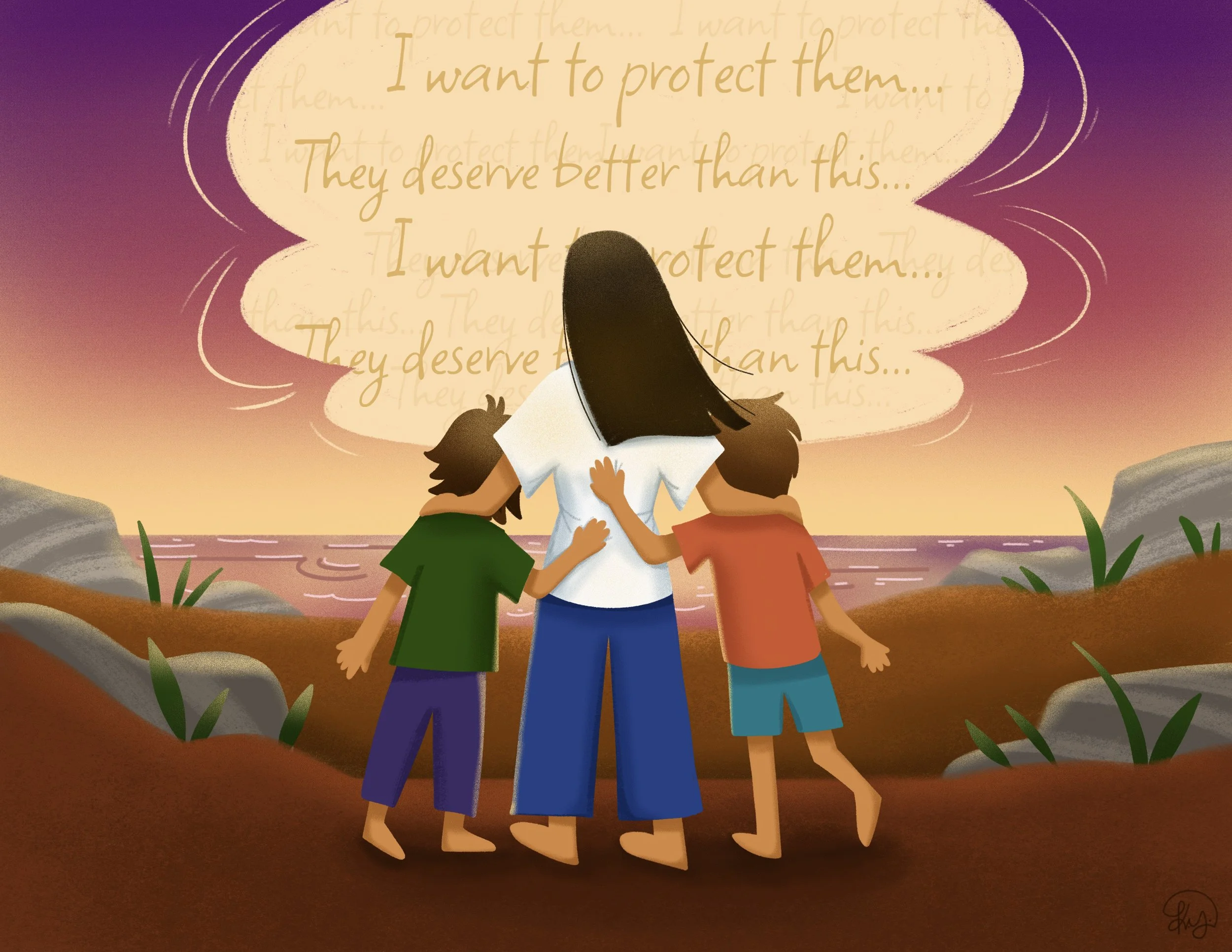
Illustration by Karenna Yang
When my half-brothers were born in 2011 and 2015, I took the second parent role with little resistance. I did not want them to experience the same things I did when I was younger; I wanted to be the emotional protector and teacher I needed but never got. I was also afraid that they’d feel just as letdown as I did.
As a sixth grader in 2012, I would make my brother’s breakfast in the mornings so my Mother could take her time getting ready in the morning. As a high schooler in 2015, I would make sure I got most of my things ready before my youngest brother woke up, so I could feed him and change his diaper and clothes.
My role as “Second Parent” garnered many compliments from extended family and educators, some even commenting on how this was “great birth control.” Over the years, I held a quiet resentment, not toward my brothers, but toward some of the adults around me. I saw how they would act toward their own children and I vowed to never do that to my brothers or my future children. I felt responsible to be “better” because none of the caretakers around me were taking accountability for their little ones. I didn’t want to become like them.
My brothers are now 14 and 10 years old; I am now 27. While I do not regret in the slightest being a Second Parent to my brothers (I love them so much), I am at a point in my life where I need to set stricter boundaries. I have been in a care-taking role for my brothers for a long time; I even chose to stay home for college because I did not want to leave my brothers nor have them forget me. My distrust in parental figures has lessened as my family’s dynamic changed; my step-father and Mother got divorced and I have done some healing pertaining to maternal wounds. Part of this healing is learning to relinquish responsibilities, because they are and never were mine to carry, and not feel guilty for needing and wanting time for myself and my partner, as we are in the planning stages of moving forward in our lives together
In a way, being a Second Parent to my brothers has allowed me to re-parent myself in this new season of life as I learn to find trust in people again, accept that no one is perfect, and especially, that I am and never was responsible for the (perceived) shortcomings of others.
If you feel like you’re in a similar position as the eldest daughter who became a “second parent,” then you’re not alone! Read The Eldest Daughters Who Became Parents to explore ways to redefine your role in your family.