
Pansori at the Oscars: An Interview with Lauren Han (full transcript)
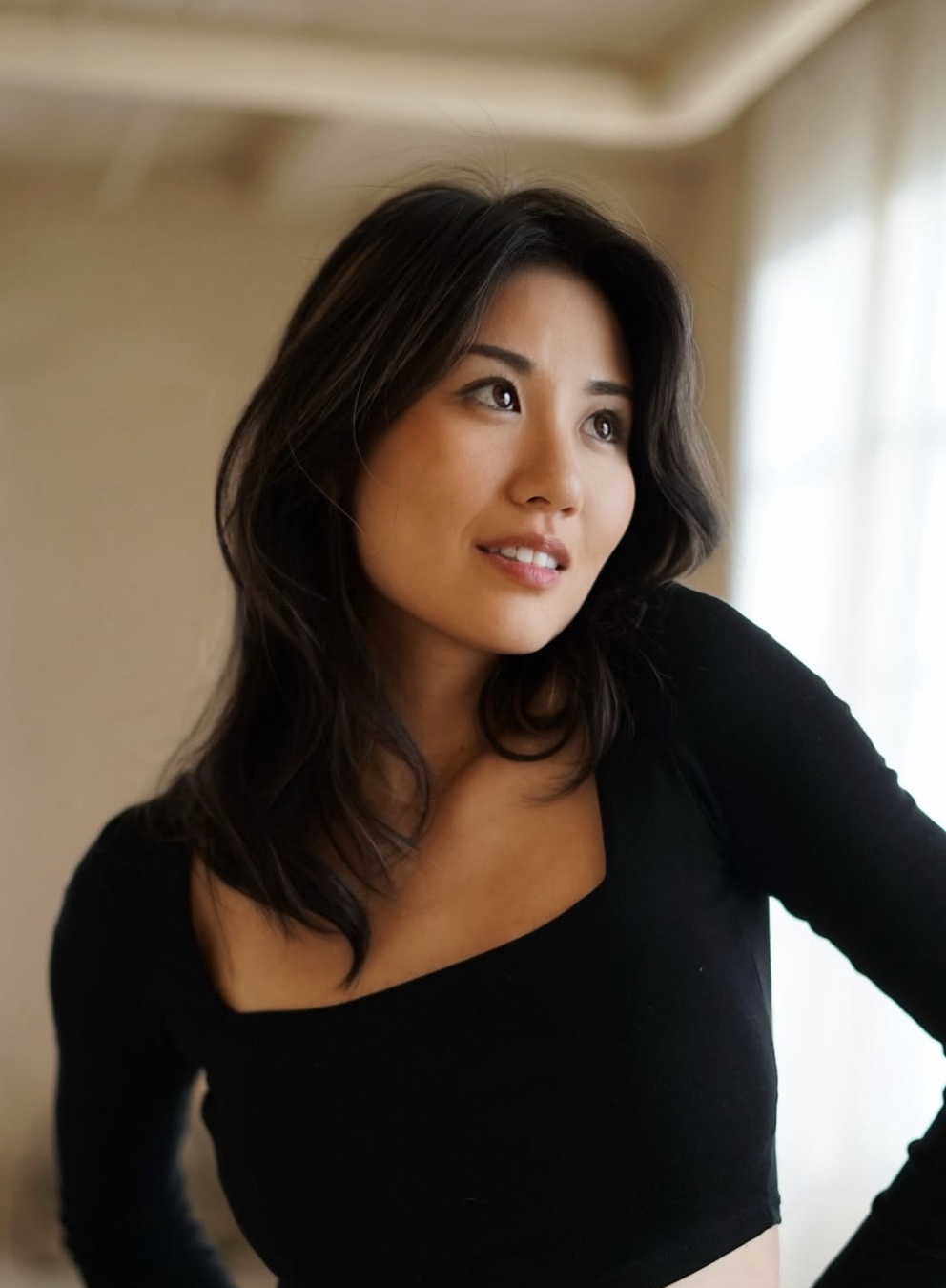
Photo courtesy of Lauren Han
2026: How It Started
NOZUKA: What was the road to the Oscars like? How did that gig come about?
HAN: So…I got really lucky. Let's just say that I was searched for and chosen. And I was very lucky to have gotten that opportunity. The road to the Oscars itself—that’s the whole road of my entire life as a performer leading up to that. But it feels like, as an overall picture, the fact that I didn't give up, didn't know where I was headed, and just kept doing what I felt I was born to do–my purpose–and just kept going.
NOZUKA: I saw that you posted in February about how the year wasn't starting so great, and then this came up. How did it feel? It seemed like a sudden shift.
HAN: Oh yeah, I definitely had a rough start to the year. I’ve had a couple of things that didn't go my way earlier this year, and just my personal life… in the past year or so. In my career, there's always ups and downs, but this one was kind of a blow.
Also, seeing how LA has kind of reduced their production, and actors [are not] sure what to do, and creatives in general are not sure where to go [with] streaming platforms and Instagram–just social media taking over.
We, as artists who aren't content creators or influencers, are now forced to do something like that, and it kind of just bogged me down for a while. I still wanted to create my own things, like filmmaking, singing, and acting, and I felt like I just wasn't able to do it. It seemed very slow, and it felt a little bit sad and a little depressed, I guess, as an industry in general.
All of a sudden, this happened and out of nowhere too. And it didn't seem like it was going to happen, but it did, and I have this philosophy of “nothing has happened until I’m there and it's already live. “
So for example, when I got this gig at Disneyland singing as Mulan–that was one of my dream come true moments–and I didn't believe that I got this job until I was on stage watching other people looking at me, and then I was like, “Okay, I got the job.” I had trust issues, basically.
NOZUKA: It wasn't real until it was real, right?
HAN: Yeah…but you just have to keep going, and not look at the result, but also just look at what you’re doing. You know the cliché: “It's about the journey.” It’s harder to admit it. It’s easier said than done. You say “Ugh, what is this journey for?”
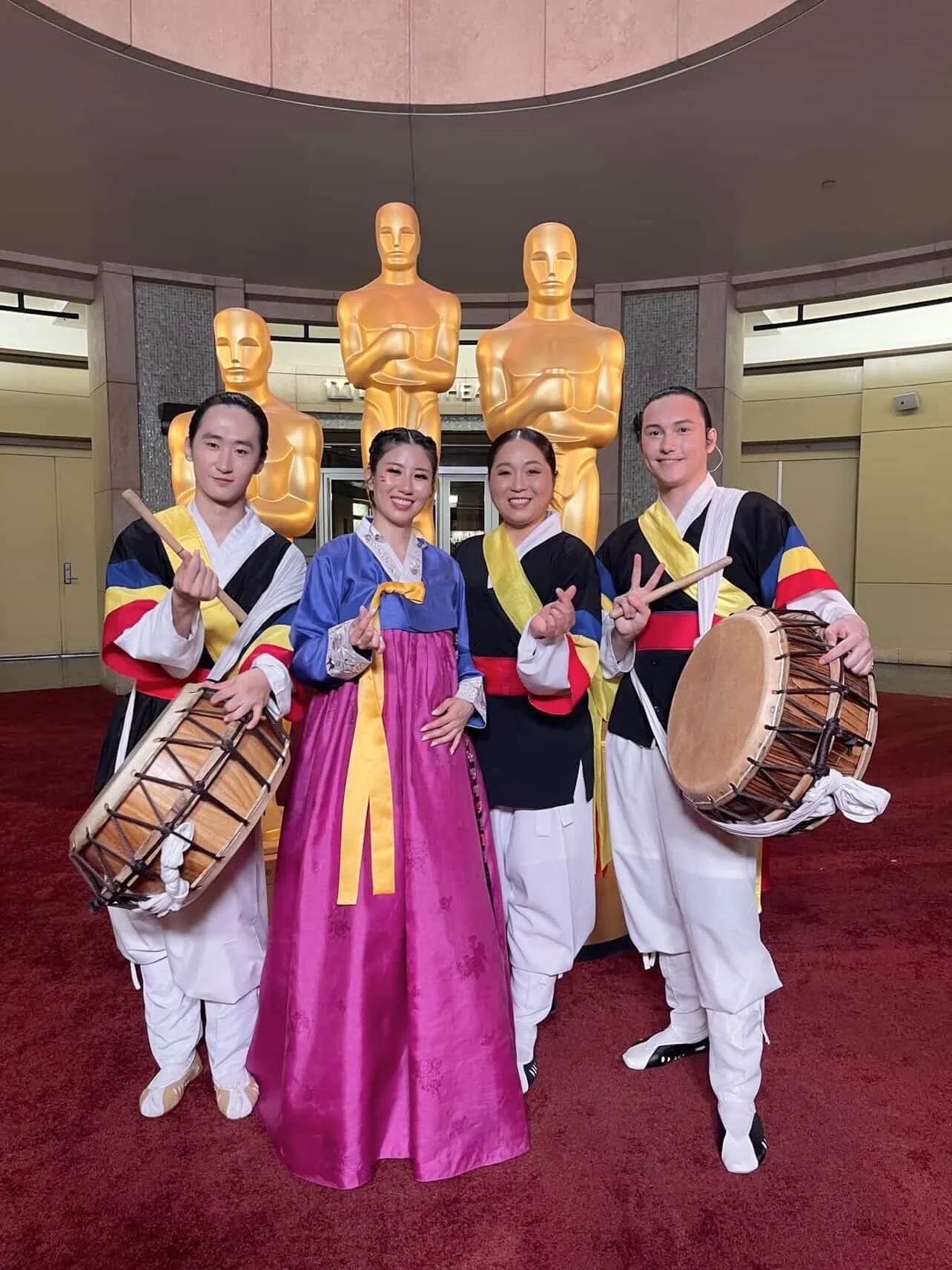
Lauren Han with pansori drummers
Photo courtesy of Lauren Han
Becoming a Writer
NOZUKA: I saw you got a creative writing certificate from Cornell.
HAN: Yeah, it was a “rip the bandaid off” kind of moment for me, because all my life as an immigrant, [I was] not really confident in my speaking and writing skills. I just kind of put that off and had severe writing anxiety also, and I just wanted to conquer it.
I looked for some writing courses online and that came up on my Instagram feed. I said, “Hmm, I’m intrigued.” This is a whole new, brand new program that started, I think, last year, and I just gave it a try. I thought I was gonna be watching a bunch of videos and not actually writing, but turns out it was an actual class and actual work, and I had to do a lot of writing.
I'm laughing about it now, there [were] so many days I was like, “I can't do this.” And so I had to extend it again and again, and a 3-month course became a 6-month course, and I barely passed it because I begged the staff, “I just sang at the Oscars, can you please give me another extension?” They were super nice about it.
But I also wanted to write because that is a part of my life that I haven’t explored even though I'm dying to. I have a lot of ideas–I have a lot of thoughts in my head that I just haven't been able to materialize or make tangible. And it was slowly just killing me.
I knew it would be so helpful in storytelling as a storyteller. And I’m really excited because I got to learn the basics of writing, but it also pushed me in ways that I've never been pushed. So I'm really excited to do my own short films, and I want to make a feature film someday. I feel like everyone should take this class.
NOZUKA: Well, you know, [Lotus Mag is] always looking for writers, so if you ever need a platform to write for… There aren’t a lot of performing artists either so I feel like you would bring something interesting.
HAN: Oh my gosh! I’ll definitely muster up the courage to write stuff and maybe publish some things I feel are worthy. But like you said, it’s great to share perspectives. I think it’s important too, there’s not a lot of us out there.
KPop Demon Hunters
NOZUKA: Going back to KPop Demon Hunters, what did this movie mean for you?
HAN: Oh my gosh. Funny thing, I actually auditioned for it 4 years ago. KPop Demon Hunters all of a sudden became a worldwide sensation, and I was kind of bitter about not doing well in the audition so I didn't watch it for a while actually. And then, my close friend was like, “you have to watch it! Are you crazy?” I watched it, and I actually love it!
It was very novel, and the message is very important, I think, for a lot of marginalized communities, or people who don't feel good enough. I saw a TikTok video saying, “Oh, my therapist recommended this movie.”
And not only that, the music is incredible–I just replay it over and over to and from work, or whenever I get in the car. Even before I got involved with the Oscars, I was obsessed with it. And then I finally got an opportunity to be a part of it, and I thought “Wow, I got involved somehow.”
NOZUKA: That’s pretty cool. Do you have a favorite song from the movie?
HAN: Actually, my favorite is ”How It's Done” and “Takedown.” I just replay those two things and get hyped up every time
NOZUKA: I feel like that would match your character, O-Ren Ishii.
HAN: Oh, yeah. Sometimes I like very calm music, but when I want to be pumped up, I really love to turn up the music. It’s so exciting, so much happening in [their songs]. Very energetic.
NOZUKA: A lot of people talk about the food in the movie. Did it mean something to you to see Korean food? Was there a certain food in particular that was like, “oh, I'm so glad that's there?”
HAN: Yeah, I guess all of the food. Gimbap was there—that's my favorite. I think it was just nice to see a representation of what we love and sharing it on screen for the world.
I saw another person saying, “oh, a Korean Korean wouldn't make something like this, because everyone knows what gimbap is, and everyone knows what ramyeon is, and they would think it's tacky. Only a Korean-American would make something like this.”
Which is actually true, because all our lives, we've been trying to hide ourselves in America. Hide our stinky food, hide kimchi, hide everything, hide what we eat, and be made to feel ashamed of what we eat. And to be displayed like that, and everyone just…yeah, it's nice to have everyone kind of interested and loving our culture, I think.
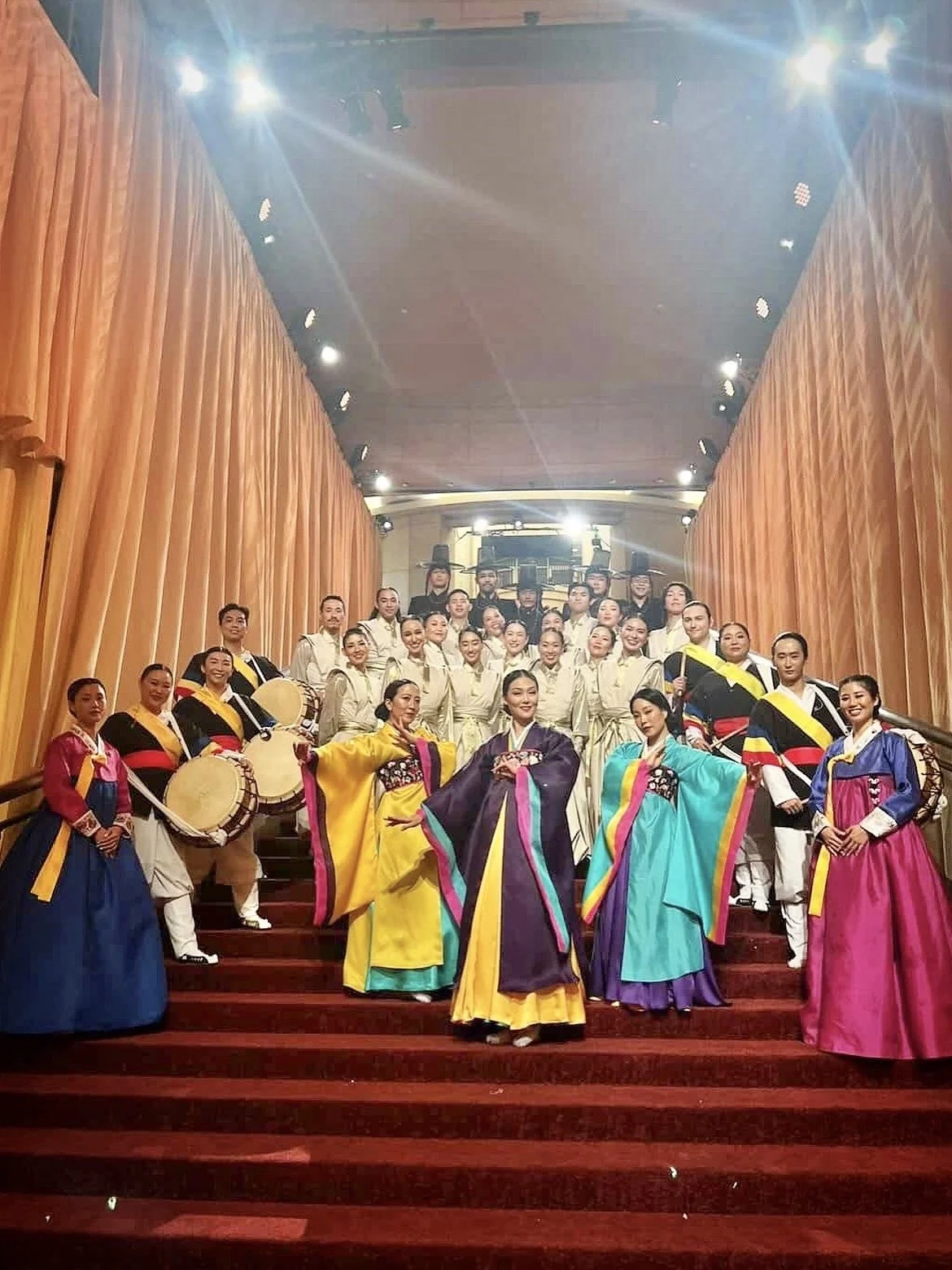
2026 Oscars KPop Demon Hunters performers, including pansori singers and drummers, and dancers
Photo courtesy of Lauren Han
Full-circle, from Korea, K-Town, and Back
NOZUKA: Were you still following a lot of K-pop?
HAN: Not for a long time until very recently. When I was in Korea, of course, I was obsessed with K-pop, the OG K-pop, I would say. And then when I moved to the US, my dad told me not to do any Korean-related things like watch Korean dramas, listen to K-pop—basically to focus on learning English and assimilating.
And I am grateful that my dad did that because I learned English super fast. But I lost touch with K-pop and Korean culture for a while. And then I moved back to Koreatown–I moved away from Koreatown because I wasn’t learning enough English. I moved back, and I started to join a lot of Korean theater groups.
The last one I did that I’m still a part of is called Vocal Seoul, a Korean a cappella group that does a lot of K-pop. It’s not a K-pop group, it’s an a capella group that covers a lot of K-pop songs. And that's when I started to really listen to a lot of songs and fell in love with a lot of them. Actually, my friend wanted to start a Korean dance cover group that I was briefly part of. I was like, no, I can't do this anymore, but I tried. And that's how I really got back into my roots.
NOZUKA: Do you feel like it's kind of a full circle then that this big Oscars moment was so Korean and traditional?
HAN: I can't even wrap my head around it still because, out of all the things that I thought I would do on the Oscars stage, I don't think any of us would have guessed that it would be… Koreans performing in a traditional-like Korean style, showing our Korean traditional outfits and dance at the Oscars–it just doesn't sound like something that would ever happen, especially for a country that's so small. And even smaller because it's divided into two. I feel like we as a country have gone through so much over the years, and we just kind of want to establish ourselves in the world, but we still feel small.
So to have that come full circle, especially, you know, growing up as a Korean American getting called names because I'm Asian and telling me to hide my identity–it felt like a healing, cathartic moment for me, and I hope for a lot of Asian people in America and in Asia too.
I know we don't go through a lot of racism like other people. [But] I knew that we, as Asian communities–we tend to hide a lot and just stay… in the shadow a little bit. [The performance] brought more confidence in us, that it's okay to tell our story. It's okay to take up space.
NOZUKA: Were your parents and family super excited? They must have been.
HAN: So, at first, I told them about this, and they didn't react much. I don’t think–I think they also have trust issues, so when something big happens, they like to wait it out and kind of be skeptical about it, saying, “Hey, make sure you do a good job.” My mom even said, “Something bigger will happen.” And I told her , “This is something big!” I think they’re kind of like typical Asian parents where they're proud of you, but they weren't able to express it until after the fact, after my face was shown on TV for even a brief second. It was all over Korean news and Korean social media, all that. And then my dad and my mom realized the impact it had.
I think they knew all along, but they were afraid to express it externally. They started to post it everywhere and show it to all our relatives and everyone in Korea, so they were definitely proud of me. But I didn't know that until after it happened.
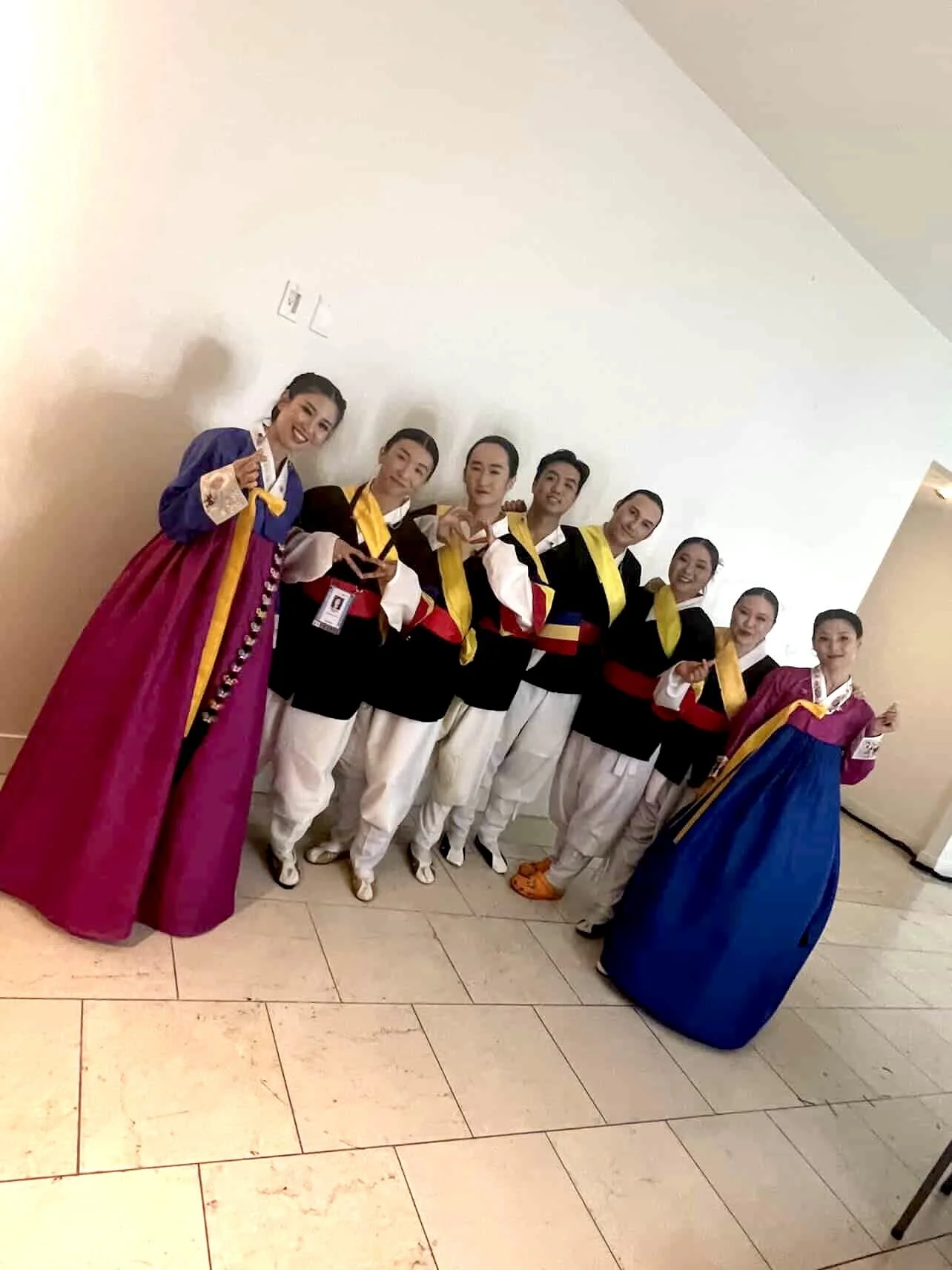
Pansori singers and dancers from the 2026 Oscars performance
Photo courtesy of Lauren Han
NOZUKA: Were most of the performers Korean-American then?
HAN: I would say they tried their very best to try and gather up as many [Korean Americans] in the amount of time that they had. There were some who weren't Korean Americans, but who cares? I met the most amazing Japanese friend, and we have become really close now.
I think it was a unifying experience for all of us, and it didn't have to be exclusively Korean people even though it was representing Korea. For me, for example, I represented Mulan, and O-Ren Ishii, and I think over time, I can graduate out of these roles, right? I was telling my beautiful Japanese dancer friend, “You need to start singing so you can take over my O-Ren Ishii role.”
Asian American Women in Media
HAN: But anyways, I encourage a lot of Asian Americans to follow their dreams. This is kind of a side, but it feels like sometimes… I know that we all, as an industry, have to try harder but… when I'm trying to look for talent, it's like, “Where are they?” They are here, but there's just not as many of us. There's not a huge pool. If there is one, she's booked, or he's flying out and performing. So, there aren't a lot of us. There's more now, for sure, than ever before, but yeah.
NOZUKA: So I guess this kind of leads into…do you think we're in a moment where there will be more visibility for Asian Americans, like Asian American women? Or do you feel like there’s still…more challenges ahead? Or have the doors been opened now?
HAN: So, yes. I feel like that was a two-part question. The first one, women feel less visible or have more visibility: to that, I would say yes. And I feel like Asian women aren't afraid to show themselves and speak up. I don't think they've ever been afraid, however, I felt like we were overshadowed a lot. But now Asian women are able to come out of the shadows with the rise of content creators on YouTube, Instagram, TikTok, etc.
Asian women are so hardworking, and they’re very earnest. And as long as they just keep doing that, keep working hard, keep caring for the community around them, and keep doing work that lifts people up. That's their strength [and] that’s beautiful. And not being afraid to be themselves— that's definitely on the rise.
But I do feel there's a sort of discrimination still when it comes to Asian women. There’s this topic of Asian fetishizing. People think that it’s a positive thing, like “well, people like you.”
Well, do they like me? Because I've worked this hard to be my person, and do you like me? Or… are you just trying this out because you're fantasizing about this culture? Which is kind of hurtful for us. We feel like, “Well, what about me?” And a lot of Asian women still feel that way, and I hope that over time, that gets melted away. I do also get a couple of racist comments on YouTube videos of me.
There’s still [a] ways to go of showing strength and not being afraid of being ourselves, whether you identify as one thing or another, a Korean or an American. [If you identify] as both, then live as both. Don't be afraid—don't hide yourself.
But I think we're doing a great job. And I think, looking at someone like you, and you’re doing all of this…it’s very inspiring, and I think we've come very far. I'm very proud of us.
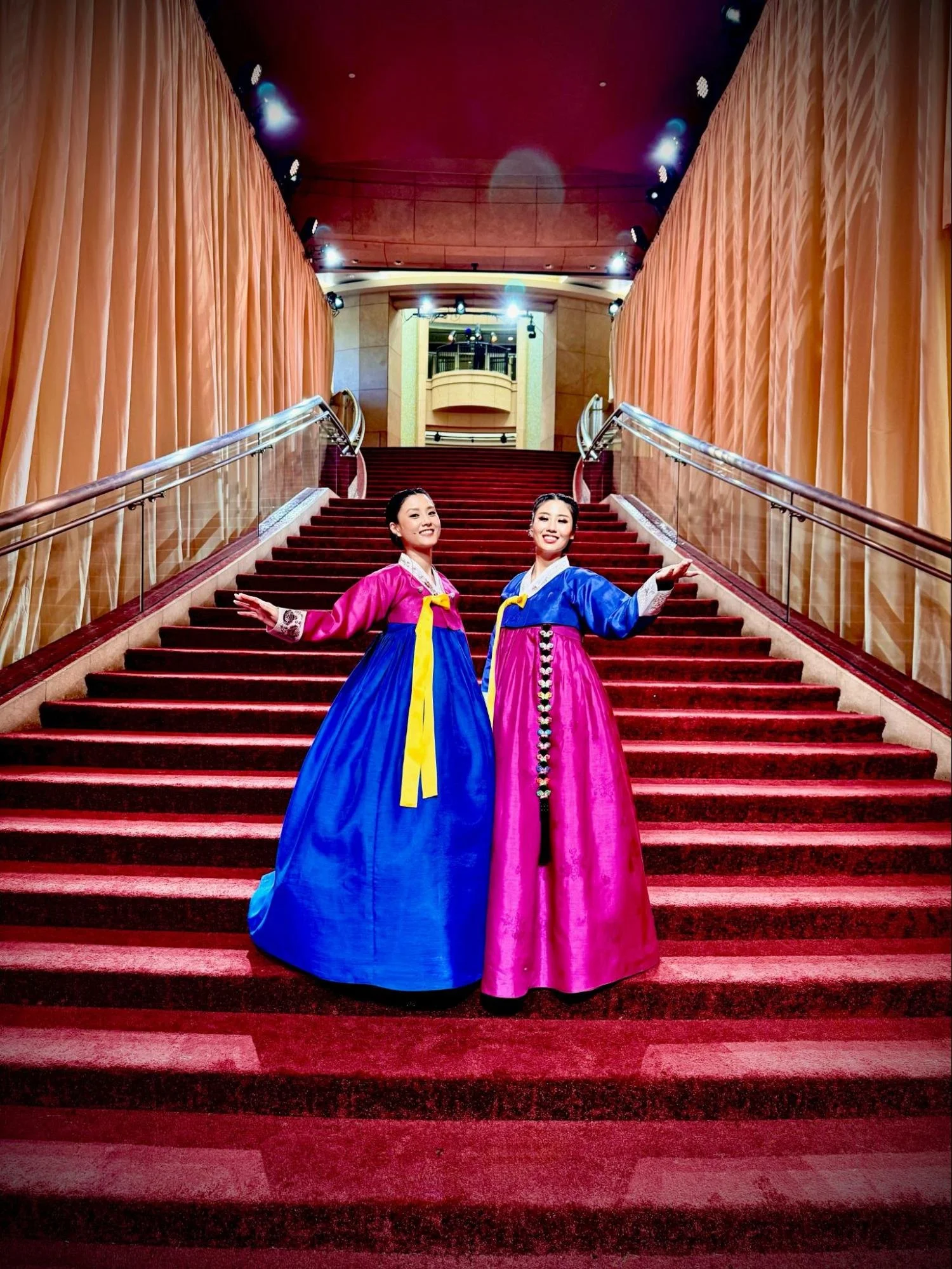
Halley Kim and Lauren Han, pansori singers for the KPDH Oscars performance
Photo courtesy of Lauren Han
NOZUKA: Yeah, I think we have too. When you're auditioning for roles, have you been able to, just, you know, go in as an actor, or do you think you’re being given roles for an Asian American woman or an Asian woman?
HAN: Listen–if I get a job, I got a job. However, there is a flipside to that. I'm now not able to be a part of something else because someone else…looks like me. So I’ve gotten a lot of those things where, oh, the lead kind of looks Asian or has brown hair, or you know—I mean, that happens all across the board, but there is a lot of that “token Asian.” Which, hey, I'm not complaining about, but at the same time, where [are] the Asian American stories…?
I know that we had a couple of hits, but I think continuing that would be great. Continuing to create more stories regarding us that's not just about: a stereotypical Asian. Because what happens when I'm chosen as a token Asian, I fall into a stereotype of some sort. It's a lot better now, but it used to happen a lot where I would get cast as a sex worker or someone who's in that world, in that realm.
It's like, okay, we're telling a story, but at the same time, what are you telling? Are you telling it from our perspective? Are you fully understanding our perspective, or are you telling it [as] just a generalized statement you want to make in your story? I think, moving forward in this industry, we should just be a little bit more mindful of other people's experience and… providing representation.
NOZUKA: Like who's writing it, who's in the room, that kind of thing, right?
HAN: Yeah, exactly. Like I said, If I'm the only Asian, that’s fine. But it just sucks because what about the other Asian girl? What if she wants to be in it–or what about me? I want to be in it when there’s another Asian girl. Why do we have to be just 1 out of 10?
NOZUKA: Right, that’s true. Is it the kind of thing, like you were saying earlier, where if they cast someone who’s Asian already, they're like, “oh, we can't cast you or cast someone else because there’s already one and like… people might confuse you two,” or something weird like that?
HAN: Yeah, it happens, it happens a lot. It's like the… diversity thing, which I encourage. But now the diversity thing is like, “okay, one here, one here, one here.” And yeah, that’s fine but it used to be that there were 7 white people, 2 diverse people, 1 Asian person. That was a problem. I saw that a lot, but now things are shifting.
We're [also] not covering the different variety of Asian individuals. Like we’re just worrying about the token as a representation then that’s just one representation, but there’s all kinds of Asians–there’s all kinds of Asian women. So I think that becomes a problem, but it's definitely changing.
NOZUKA: I was curious what you thought about–you know, people have varying opinions on having an Asian accent when you act. Some people have said, “oh, don't make me do that because that's not my accent.” Other people have said, "well, you know, I'm honoring my parents [who] speak like this.” What are your thoughts on that?
HAN: For me, I have no problem, I just wish I was better at it, which is odd because I grew up listening to Korean accents and I used to have a Korean accent. As an actor, I think it's kind of our challenge to push ourselves while honoring the other person. As long as there's love there and respect there, I think it's okay to put on the accent. If you feel uncomfortable, then of course don't do that, but I don't know where I stand yet.
I honestly don't have a problem with putting on the Korean accent because I'm okay with that representation, but I wish I was better. I just don’t get a lot of these. If I'm putting on the accent for a very stereotypical role, then that's not good, but I haven't seen much of those in recent years. But I think that's up to the individual, for sure.
NOZUKA: Yeah, that makes sense. It's all very nuanced.
HAN: Yeah, as long as it's respectful, and you're doing it out of love, and it’s like, “yeah, my mom speaks it, you know? Like, my dad.”
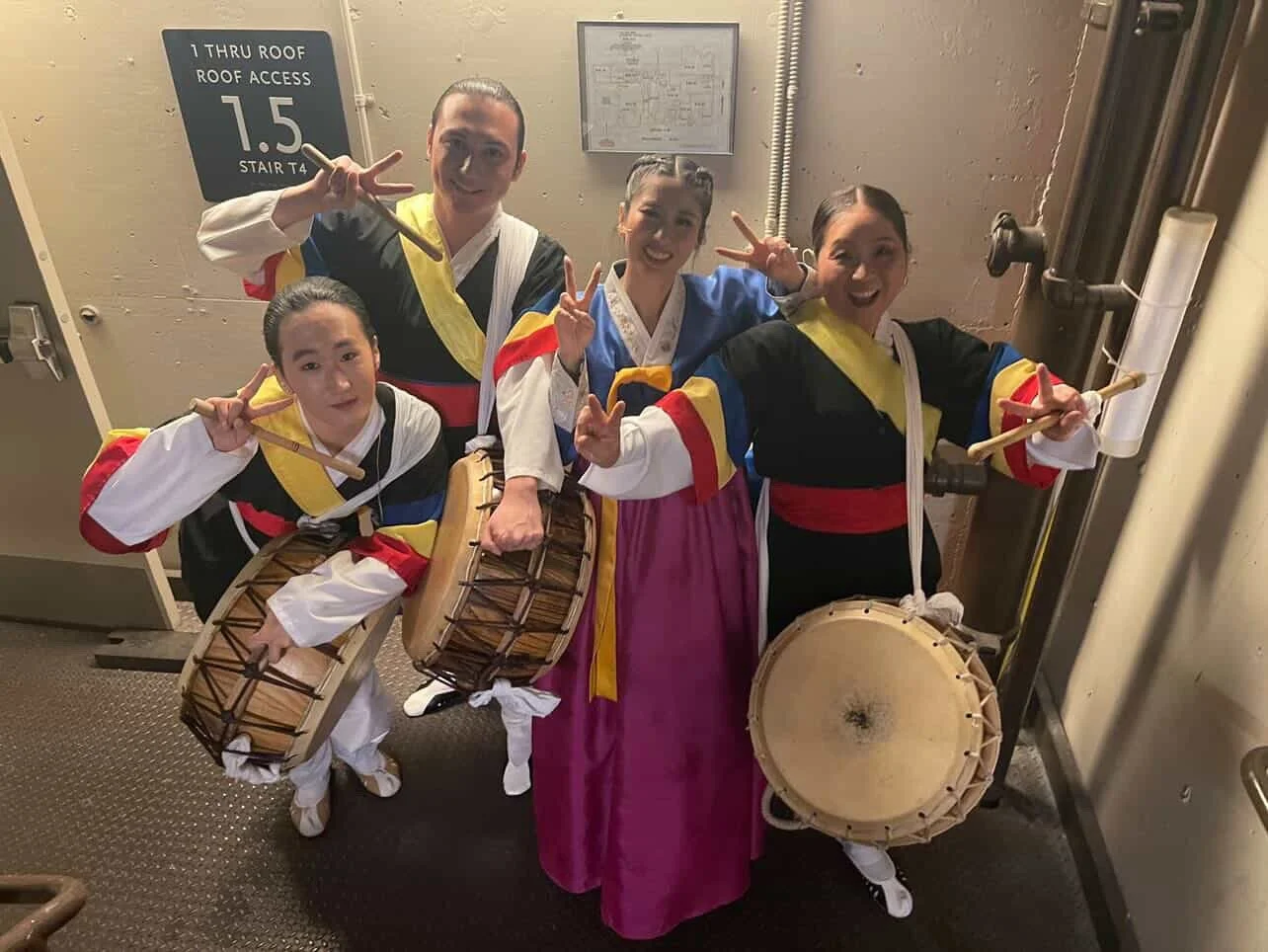
Lauren Han with pansori drummers
Photo courtesy of Lauren Han
An Actor Who Sings
NOZUKA: I found an old interview you did, and you said something about being more of an actor who sings versus [being] mostly a singer. Do you still identify that way?
HAN: Oh, I've always identified more as an actor than a singer… because when I only do singing, I'm just not happy. So when I’m singing, sure, the notes, the quality of voice–all of those things are of importance and of my concern, but as soon as the storytelling goes away, my entire soul leaves the song. I don't know if that's the case for a lot of people. I think a lot of singers are not actors–they're more focused on the musician aspect of it. That's why I went into musical theater because I was able to do both, and even when I do pansori in the Oscars–
Pansori is like storytelling with your singing. It can’t be either or. It can’t be just singing–it has to be also acting and singing. So for me, those two have to go hand in hand. Of course, when I’m singing in… Yeah, no, I don’t think there is an exception…
Even in studio recording, if there's no storytelling, there’s no acting, why am I singing this part? So that’s why I think I would not ever want to be touring in a band, or something like that. Touring as a singer because if that’s the only thing I do, and not… any kind of acting or filmmaking–
Not that musicians aren't storytellers–of course they are, but I think there's a huge difference. I think there's a singer who sings only, and that's their focus, versus a singer who likes to also act. There's a spectrum of “Where do you want to put your scale?” And I want to put it right in the middle, or right on the 60, or even more sometimes, all the way to 90%.
And a lot of my singer friends, I ask them “hey, do you want to be a part of my short film?” or “do you want to be a part of this?” They're like, “oh, no, no, no, I can't act.” But they have incredible voices. I feel like a lot of singers miss out on that opportunity, but… I think that’s okay. I think it's their prerogative and their focus so I have nothing against that. But that's just not me.
NOZUKA: It feels like you know yourself well.
HAN: I mean, it took a while, but I always have known that I will not just be a singer, because it will just… ugh, I feel like it's soul-crushing to me.
NOZUKA: That’s interesting. I think when we were [in college] together, I didn’t know, because you were mostly doing choir and that kind of thing, right?
HAN: Yeah,I did choir, but in the meantime, I was also taking acting classes and dancing classes. So when they pushed me in that direction of “are you gonna be an opera singer” and “are you gonna go into singing?”– I was kinda pushed there by a lot of people, professors and teachers. And they were all pushing me in that direction of ‘okay, these are the steps to becoming a singer, an opera singer, or a choir singer,’ but I knew that there was a part of me that loved filmmaking and acting.
And I saw an interview of a couple of opera singers who… [were] reprimanded for acting too much while singing. And that's when I had a whole identity crisis. Because I was like, ‘well, if I can't act while I'm singing, then I can't do it.’ So I kinda gave up that whole–it kind of put me in a spiral. I had a whole quarter-life identity crisis. I said ‘what am I doing? What do I really want?’
And so that's when I shifted from opera singing, and just doing all this music, music, music, music, to ‘okay, let me just take a pause and maybe I can go back to musical theater.’ Because I used to do musical theater, and I liked musical theater. And I shifted more towards also acting in LA, and just getting involved in the filmmaking world, as well.
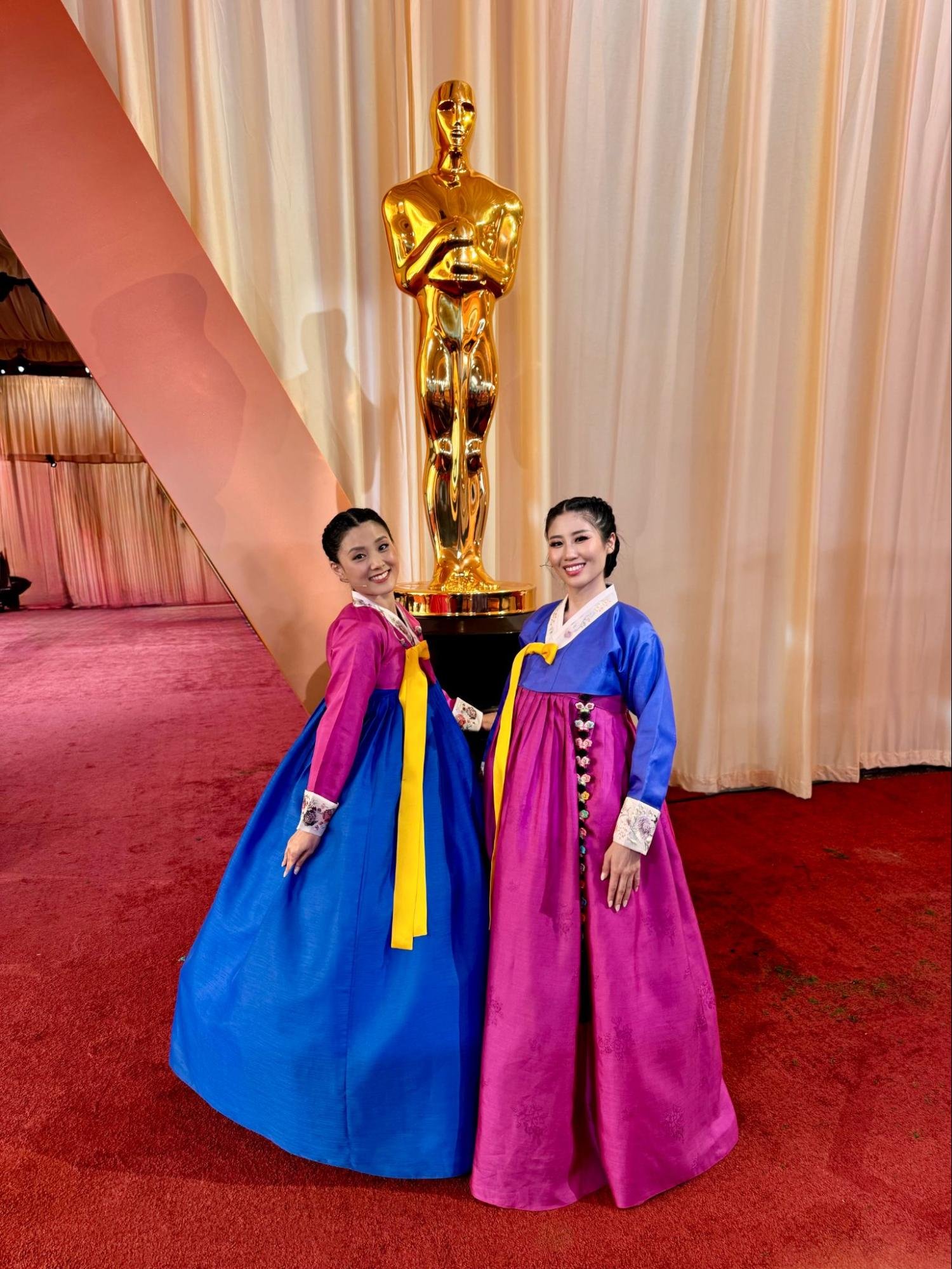
Halley Kim and Lauren Han, pansori singers for the KPDH Oscars performance
Photo courtesy of Lauren Han
Pansori at the Oscars
NOZUKA: So you said pansori sort of encompasses all of these things that you enjoy.
HAN: Pansori is like an opera, but it’s all taking place in your body, in your voice. There’s no limit in pansori. Pansori is trying to imitate all the sounds of the world, all the emotions, all the happy, all the sad. You're never going to be shamed about making the strangest sounds [and] making an ugly face to emote. There's no shame, I feel, when it comes to pansori. Of course, there’s a craft, right? There's a skill level that you have to work up to but that's what I really like about pansori even though I'm not a professional pansori singer.
When I first started learning it, I thought, ‘oh, wow, this is very natural for me.’ Maybe because I was born in Korea, or I did a lot of Korean traditional musicals, where I learned a lot of Korean music, Korean traditional dances, and sounds and pronunciation. A part of me thought, ‘oh wow, this is very natural for me’–the storytelling aspect, the recklessness of it all. No holding back kind of thing.
NOZUKA: You must feel a lot of freedom on stage.
HAN: Oh yeah, I think that is completely cathartic… In the pansori community, they say that if you–if a pansori singer does the right job–or the great job–the people around listening to it… the room will feel something out of this world. [Something] ethereal, something outer world.
I think that’s true, and I felt like it happened on the Oscar stage. Not to toot my own horn but it was more that everything clicked together, everyone was in that moment together. And I, as a pansori singer, had to bear the responsibility of representing my culture [for] a lot of people.
I studied a lot, and I practiced a lot, and finally that moment came, and I did it for other people–not for my glory, but for everyone who's ever suffered or felt… any type of hardship. I sang it for those people, and I think that’s [why] everyone had really positive feedback, because we were doing something that unites us, that really brings us together. And it was very human, and I think a lot of people crave that now, you know? Connections.
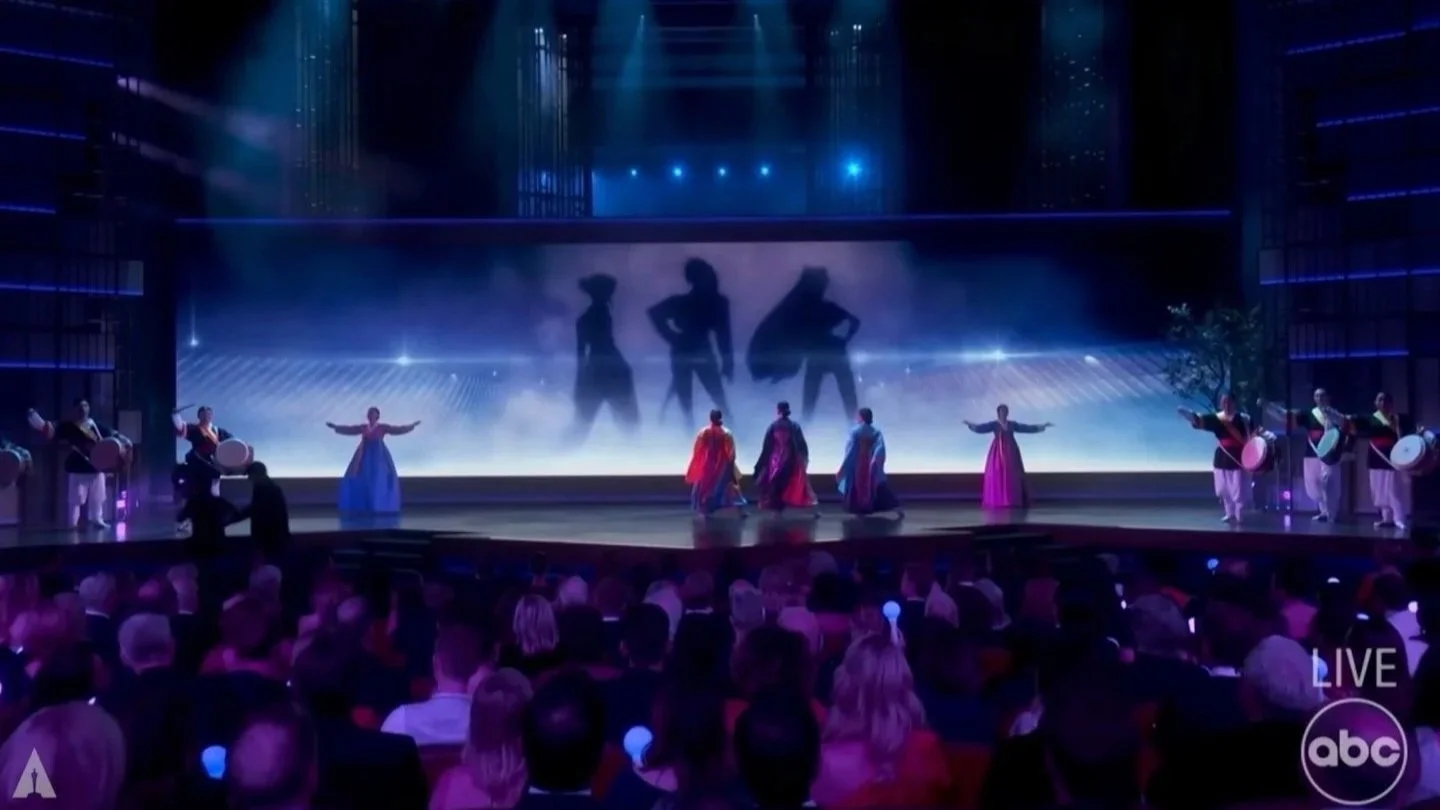
Performers of the Hunter’s Mantra
Photo courtesy of ABC
NOZUKA: Right, I remember EJAE said something similar about her first performance of Golden, where she was kind of terrified because it was such a big moment. But thinking about what it meant for other people allowed her to just really perform.
HAN: Yeah, exactly. And that was my experience. Every time I wanted to faint because of how many people were watching, or what kind of celebrities were watching me… I just narrowed my focus. I said “okay, I'm singing this for these people, that’s it.” Or “I'm just singing for this one person, that’s it.”
And then as soon as I stepped on stage and saw the flickering lights, I felt like they were cheering us on. It was no longer about me, it was about all these other people that we were doing this for.
NOZUKA: Have you already seen the impact of having performed at the Oscars? Are people reaching out to you? I feel like a lot of people are probably asking about this performance, for sure.
HAN: I'm surprised, like for me, it went by so fast, right? Like I stepped on stage, I was out of there in less than a minute. My face was only shown for 2 seconds… maybe 2 more seconds than I thought I was going to be shown, and closer than I thought.
All of this coming together, it wasn't just my performance–it was all the dances, all the music, this incredible music, and the coaching that the producers did, and the amount of detail and work that was put in in this tiny little moment. People saw a little bit of our effort, and that was like, “Ugh, gosh, we're so relieved.” I can't even imagine if it went the opposite direction of “Oh, we failed them,” or “We disappointed them.” And I think most people… gave us positive feedback.
And some of these videos–they’re all going viral, and I didn't expect any of this. I thought, “okay, maybe a few people will notice.” But I didn't know that it had such a huge impact on a lot of people. I’m still…I still can't really compute how much…the impact that this has had on other people. I still don't really know. But when I hear it from people, then I realize “oh, wow. It really did.”
NOZUKA: I remember seeing Arden Cho like 10 years ago. [KPDH] was sort of her breakout moment, but she's done so much work, and EJAE and you too—you’ve done so much work and maybe it hasn't always been seen, but now people know your face. I hope it opens a lot of doors for you.
HAN: Thank you, I actually have been getting a lot of interview requests, and a lot of performance requests, and it’s been overwhelming so I had to narrow down what I do each day just so that I can stay afloat with all the requests. I actually had to quit one of my jobs so that I can focus on getting through this moment in my life and use this moment to get momentum going, and create things that I've always wanted to create with people. And collaborate more.
And I'm just very thankful–so, so, so thankful and grateful that I got this opportunity. Honestly, I didn't know it was gonna be this life-changing. It's crazy. It’s really wild, and I'm just grateful, and I'm [not] going to take anything for granted and just work hard and keep going.
Mental Health
NOZUKA: So through the good times and the bad times, how do you take care of your mental health? You mentioned letting go of something to give yourself more time, which is great. Do you have any other suggestions or advice?
HAN: So, without going into too much detail, throughout my personal hardships, I think I pushed myself a little bit too hard. I didn't give myself breaks. I haven't gone on a single trip for like 2 years, not even outside of my area, like LA. I didn't really see my friends, and I just worked, worked, worked, and overworked.
I was exhausted all the time, and I think that really mentally drained me. And I wasn't putting myself first, I was always putting other people first, and that was detrimental to my mental health. I'm now focusing more on what I want to be doing and just realizing that I'm human, that even though on my schedule it looks like I can fit all these things in, I don't have to do 5-6 different things. I can just do one thing at a time, and really do those things well, and take frequent breaks. I think, ultimately, I was burning myself out. And I really don't recommend that. It didn't help me in my career.
I think going to my therapist really helped me. She said, “Lauren, you're doing so many things, but what do you actually want to do?” It's because I had low confidence in my abilities that I had to stretch myself thin just in case I can't make it or just in case I need money. LA is very expensive. I just didn't trust myself.
I had to quit one of my jobs. I had to narrow my focus. I still have other jobs lined up, and all these opportunities lined up, so thank God. And it's easier for me to say that now, but I wish I had given myself breaks as much as I can, and take that trip, take those sick days, who cares? Just take care of yourself and rest. I've ignored my body and my system for so long that… physically, I was showing symptoms of sickness, headaches, and stomachaches. I had to tell my boss, “Hey, I think this is–it’s my time.” We shouldn’t be afraid. We're human! We’re human.
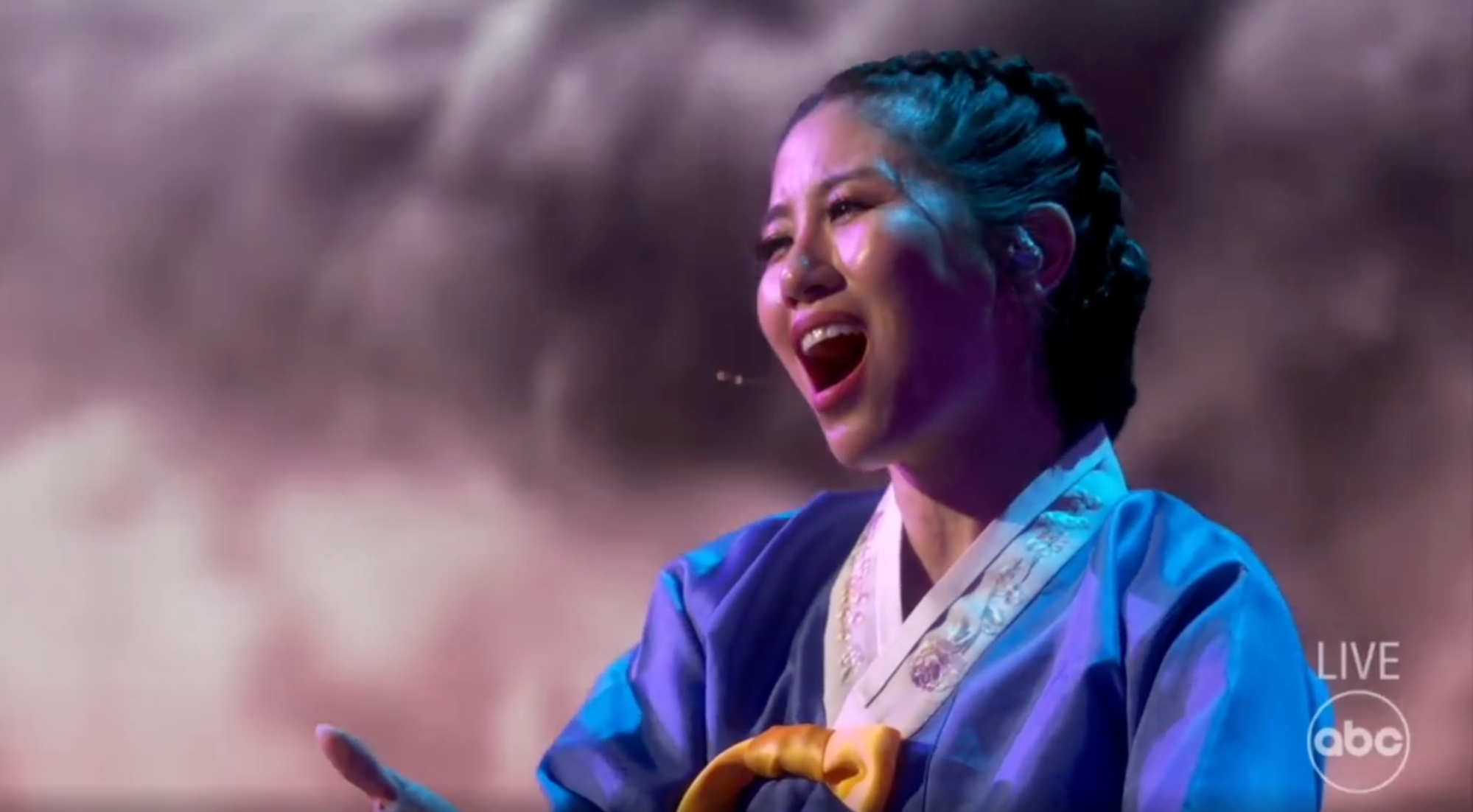
Lauren Han singing the Hunter’s Mantra
Screenshot of Oscars performance, courtesy of ABC and YouTube
Advice for Those Pursuing Their Dreams
NOZUKA: Do you have any advice for young women or people who see you and they’re like, “I want to be where Lauren is”?
HAN: So, when I was growing up, I didn't really have me, you know? But I looked up to someone in my head that could be me by looking at someone that I wanted to be. So for example, I was walking by the Disneyland show, which was Snow White at the time. I thought, “oh, it would be so great if I could sing in a place like this at Disneyland in this beautiful theater. But I will probably not [be able to] do it because they only will pick white people. But there I was [playing Mulan], right? So if you don't see someone else do what you want to do, don't ever limit yourself. You can do whatever you want to.
I’ve had a lot of ups and downs. I don’t even think people should want to be me, but I think it's important for young women to really journal or talk to people and soul search what they really want to be doing. Try to put your energy there, and let go of things and people that are draining you, and just keep going.
Who cares if people say, “you're not being realistic,” “this isn’t realistic,” or “this is getting nowhere.” I've been told so many different things: “you're too old,” “you're too Asian,” “you're not Asian enough.” I'm never enough for someone.
So all [you] can do is really just focus on that and also loving yourself and being proud of who you are, and investing in yourself, investing in what you’re doing, what you want to do.
And if you want to try a few things and fail at it, great! I think failing is the best thing I've ever done. A lot of failures in my life, a lot of rejections. So when they see my successes and the road to getting to the highlights of my career, it's easy to say, “oh, it's because she has a special thing, or she just got—”
No, I'm a normal person who just, every day, did a little bit something towards the goal that I wanted to go to. And there's nothing that should stop anyone at this point… at this moment.
NOZUKA: I love that, especially the part about doing one thing everyday.
HAN: Yeah, just little things. Think big. There's a vision board on my wall… There's a book I want to read–it’s called Think Big, Act Small. I haven’t read it, but it is true.
I don't know what the book says, but think big, act small, every little thing counts. Even if you tell yourself, “ugh, today, I wasn't productive enough.”
I think Asian women are perfectionists—they're so goal-driven, they push themselves too hard. And that was my problem. I pushed myself way too hard, to a point I was burning out all my candles.
So be gentle on yourself, be easy on yourself, but know that those little things do matter and compound over time.
Atomic Habits is actually a great book I read last year, talking about small habits resulting in big changes. I highly recommend it!
NOZUKA: I think you should write a book.
HAN: I should write a book—I’ve been wanting to! No, honestly, I’ve been wanting to and that’s why I took the creative writing class and hopefully, maybe write a book someday.
Future Projects
NOZUKA: So I know the hour is pretty much up, but my last question was, is there anything you would like us to look forward to seeing you in, or projects going on?
HAN: Honestly, each day for me is different. But I am excited to pursue more of what I want to be doing. Going back to what I said about aligning my goals and aligning my direction, I'm going to keep going in that direction and clearing the paths that don't serve me, or drain me or are unhealthy for me. And I hope that over time, you'll be able to see me in more projects that tell Asian American stories or just interesting stories in general.
And I want to incorporate music in a lot of my storytelling, [even] it's just me singing at a concert—you can look out for that. And I'm gonna be producing a lot, making a lot of singing videos with my friend, my singing partner, Halley Kim. So follow us on TikTok and Instagram. I'm really excited for this journey ahead!
NOZUKA: I've seen a couple of your videos that you've done. They’re both—you're both so great.
HAN: Thank you so much! Yeah, we're trying. We're really using this opportunity to make more, showcase our culture more, or you know, just singing in general for fun.
NOZUKA: Yeah, why not? It's the right time.
HAN: Always, it's always the right time.
Follow Lauren Han on socials!
Instagram: https://www.instagram.com/laurenhanofficial/