
Biba Mes CHamoru!
Finding Pride in Our Ethnic Background(s) and Celebrating CHamoru Heritage
Clipart from Canva (free asset)
Honoring aspects of our ethnic identity is vital for reclaiming stories muddled by colonial erasure. Mes CHamoru, a cultural testament to Pacific Islander indigeneity, serves as a powerful reminder of the beauty of celebrating what makes us, us.
Cultural Awareness: Embracing the Sum of All Parts
All 12 months of the year have at least one awareness theme attached to them. You may be aware of a few: January is considered Mental Wellness and Cervical Awareness Month, April is Earth Month, September is National Suicide Awareness Month, and October is Breast Cancer Awareness Month.
Along with these, there are allocated calendar dates dedicated to different ethnicities and cultures. Commemorating the plethora of ethnicities that make up our loved ones is a powerful way to reclaim indigenous and cultural stories, venerate our ancestors, and truly honor and protect the diversity that adds to the complexity and intersectionality of our world.
One such month where this is demonstrated is Mes CHamoru.
An Example of Celebrating Culture: Biba Mes CHamoru!
March is Mes CHamoru, a celebration of CHamoru (Chamorro) language, traditions, and history. A 2015 article by the Guam Visitors Bureau mentions Mes CHamoru was established in the 1970s as an initiative within the Guam public school system, which then expanded into an island-wide observance in the form of fiestas (festivals or gatherings), where attendees can see, learn, and participate in dances, weaving, and other cultural demonstrations.
Although Mes CHamoru is celebrated specifically during the month of March, its representation of enduring indigeneity and cultural identity is something that lasts much longer than one month.
The term “CHamoru” is the name of the indigenous people of Guåhan (Guam) and the Northern Mariana Islands, which is a U.S. unincorporated territory that comprises 14 islands including but not limited to Saipan, Rota, and Tinian. “Chamorro” refers to the same group of indigenous people; however, the name is derived from the Spanish language. “CHamoru” is considered a reclamation of the name without Spanish influence and with care and attention to how the word is pronounced in Fino’ Chamoru (CHamoru language).
According to an Instagram post by The Guam Bus, one could say “Pulan CHamoru” as opposed to “Mes CHamoru,” which has a root in Spanish (“Mes”). As mentioned in an Instagram post, The Guam Bus explains that the word “pulan” can refer to the words “month,” and “moon.” When it comes to “Pulan CHamoru,” “pulan,” in this context, is “to watch over” : “Pulan Chamoru” can mean “Chamoru Month” but also a call to ‘watch over or care for Chamoru things” whether we mean culture, language, rights, lands or waters.’”
A (Brief) Historic Overview of the CHamoru People and Guåhan
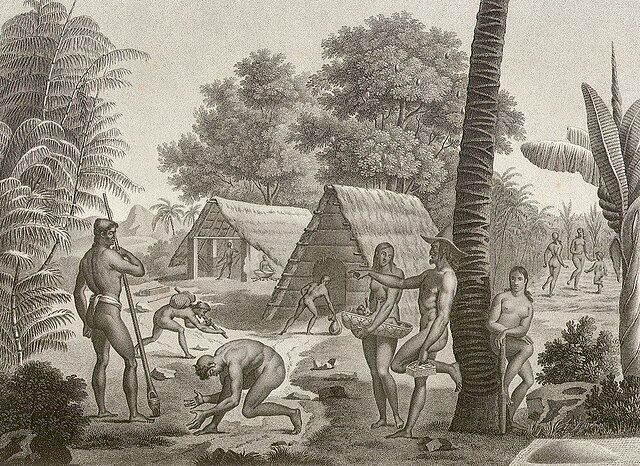
An image depicting ancient CHamoru society
Image courtesy of Wikimedia Commons
Part of reclaiming CHamoru culture is by sharing the history of the people before colonization.
In this section, a brief overview of the history of CHamoru people on Guåhan will be covered, as it is not possible to fully encapsulate the richness of CHamoru heritage in a singular online article.
According to Kristin Oberiano, an educator and writer with the Organization of American Historians, Guåhan is most often discussed in context to weather events, such as typhoons. One such event was Typhoon Mawar in May 2023. Guåhan’s representation in American education rarely includes indigenous, CHamoru perspectives so it is essential to approach this topic with an understanding of this nuance.
Not many people know of Guåhan or the Northern Mariana Islands; the island chain played a pivotal role in World War II via island hopping and the Battle of Guam. Guåhan, a U.S. territory, is also occupied by multiple military bases, Andersen Air Force Base and Marine Corps Base Camp Blaz to name a few.
Like Hawaiʻi, Guåhan has a strategic defensive location in the Pacific Ocean, making it one of many places the U.S. military utilizes for bases, training and a “pawn in the frontlines of war.”
Oberiano describes the history of Guåhan using the following timeline: the colonization of Guåhan began in 1565 when Ferdinand Magellan landed on Guåhan and claimed the island for Spain, which led to the Spanish colonization for over 300 years. After the Spanish-American War in 1898, the Treaty of Paris deemed the island a U.S. Colony. During this time, Guåhan was governed directly by the U.S. Navy, with Naval captains overseeing the population through one to three-year terms. The U.S. Navy instilled what Oberiano calls anti-CHamoru laws, including banning Fino’ CHamoru and holidays, in an attempt to Americanize the island.
Anne Perez Hattori expands on these laws in her article “Navy Blues: US Naval Rule on Guam And The Rough Road to Assimilation, 1898-1941,” where she mentions that all education was to be taught in English and all fiestas were forbidden.
Despite these restrictions, CHamoru culture endured.
The U.S. surrendered Guåhan to Japan, whose forces attacked the island on December 8, 1941. The Japanese Occupation lasted for 32 months before the Battle of Guam, where the U.S. recaptured the island. From then, the U.S. pushed for new infrastructure and ushered in “a new age of American modernization in Guåhan.” The island remains a U.S. territory and as of 2023, Oberiano states that “Guåhan has yet to vote for self-determination,” a testament that U.S. colonialism is still in-place.
CHamoru Culture and the Role of Women
Islands and their communities are much more than chess pieces for the world stage. From a physical migration point of view, the CHamoru/Chamorro people are believed to have descended from Austronesia (area of modern-day Taiwan), and settled the island of Guåhan and the Northern Mariana Islands; however, the CHamoru people have their own creation story: Puntan and Fu’una.
According to another article by Hattori, Puntan and Fu’una are brother and sister, respectively, who planned to use their powers to create parts of the world. Puntan instructed his sister to use parts of his body to create the Sun and Moon, made from each of his eyes, the earth, which was to be made from his back, and rainbows, created from his eyebrows.
Fu’una used her spirit and energy to do this, allowing “the Sun to shine and the earth blossom.” After completing what her brother asked of her, Fu’una decided to do the same; her body created Fouha Rock, also known as Creation Point. Fouha Rock is located close to Humåtak Bay, in the southern part of Guåhan. From this rock, the first humans came.
Hattori explains that the oral history of Puntan and Fu’una informs aspects of CHamoru culture pertaining to gender roles and a matrilineal system.
The story of Puntan and Fu’una demonstrates how men and women are viewed as equally powerful contributing members to CHamoru society. Hattori adds that, even in politics, this balance is reflected in the concept and titles of maga’låhi (meaning “leading son”) and maga’håga (“leading daughter”).
CHamoru people practice a matrilineal system, where the brother-sister relationship is “considered absolutely permanent and completely reliable.” Brothers and sisters worked together to “protect family property, raise the children of the family, and generate assets to keep the family well endowed.”
Women’s roles in CHamoru culture can also be seen in other aspects of society. In a Guampedia article by Tanya M. Champaco Mendiola, land and resource allocation was passed through the mother’s side of the family, and women oversaw “the household, weaving, food preparation, pottery making and inshore fishing.” All decisions would be made only after women’s input were heard and taken into consideration. Women could also be traditional healers, called suruhåna – derived from the Spanish word “cirujano” – who would create åmot (herbal medicine) to help the populace heal from ailments.
CHamoru culture and history are expansive, and this article does not cover every aspect of it. It is through celebrations such as Pulan CHamoru that the stories of Guåhan and the CHamoru people continue to be shared, honored, and de-colonized.
Returning to The Roots: Resources To Reconnect
Reconnecting with and learning more about one’s culture can be both exciting and intimidating depending on access to direct resources. If you’d like to learn more about your ethnic background(s) and ideas on how to start, the following list may have helpful suggestions:
Speak with elders
Spending time with elders in your family and older folks can be a foundational step in cultivating conversations and community across generations. You could ask them questions about their upbringing and cultural practices they partake in, which can serve as a baseline to educate yourself on different cultural aspects. One may also look into volunteering at local care homes that service those within their ethnic communities to do this.
Integrate traditional recipes into your cooking plans
A fairly accessible way to learn about one’s culture is through cooking traditional and/or regional dishes. While access to specific ingredients may cause some pivoting while grocery shopping, incorporating vegetables, starches, and spices commonly used in your culture can make the process of reconnecting with your roots a culinary exploration.
For CHamoru/Chamorro recipes, Annie’s Chamorro Kitchen, Guam Mama Cooks, and The Guam Guide provide recipes, videos, and blog posts exploring traditional and fusion recipes for folks to enjoy. My personal favorite Chamorro dishes include red rice with lots of bacon bits, chicken kelaguan with titiyas, gollai åppan lemmai (breadfruit cooked in coconut milk or cream) and latiya (with a generous amount of cinnamon on top)
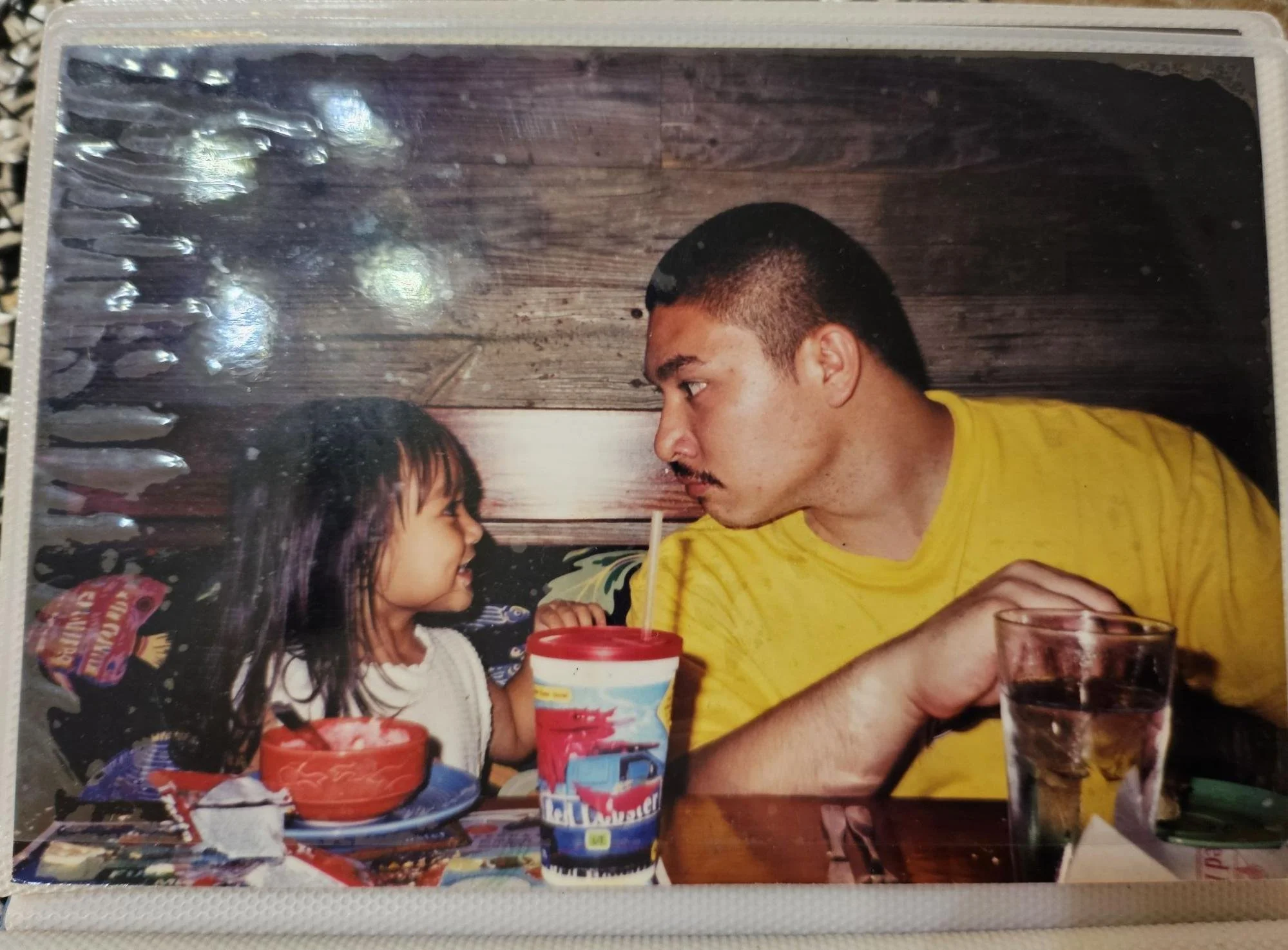

Kai, who is part Chamorro, was raised with Chamorro food thanks to her biological father, who often made red rice and other foods for family BBQs
Image courtesy of Kailanianna (Kai) Ablog
Read up on mythology and folklore
While the existence of figures in and from mythology and folklore can be contested, learning about the stories spoken and shared by one’s ancestors can provide insights on traditional cultural beliefs, as well as representations of societal views and ideals within the themes and creatures that appear. An example of this includes the aswang from Filipino culture. According to Sapphire Sandalo, known for her many works including the “Stories with Sapphire” podcast, she mentions that an aswang “represents a rejection of Filipino values.”
For those looking to read more about CHamoru stories, the book “CHamoru Legends: A Gathering of Stories” can be a valuable resource. Lotus Magazine also published an article about taotaomo’na, CHamoru/Chamorro ancestral spirits, for our “Legends and Lore” issue, accessible here.
Learn the language
Learning the language spoken by your ancestors can bring a sense of pride and closeness with fellow language speakers. Thanks to a plethora of language learning apps, initiatives, and programs, gaining access to learning materials is becoming more widespread.
For those who are interested in learning Fino' Chamoru (CHamoru/Chamorro language), there are many options including, but not limited to, The Guam Bus, a creative collective that produces creative and educational works “designed to inspire and educate the Chamoru people about their heritage and future possibilities as a people” that also offers Fino' Chamoru lessons via Zoom, Lengguahi-ta, a website “dedicated to creating and sharing learning materials for Chamorro language,” and LearningCHamoru.com, an online platform meant “to facilitate and advance the learning of CHamoru.”
Support creatives within your communities
Life influences art, and many artists incorporate cultural stories and values into their creations. A few of my favorite CHamoru/Chamorro artists include Gillian Dueñas, whose art includes prints and stickers that centers “her stories and perspectives as an Indigenous woman told through traditional legends, motifs, and aesthetics brought into a modern context,”and Kalany Omengkar, who works with various visual mediums to create works inspired by “the diverse Micronesian islands and their cultures” as a means to “share his community's stories, history, and traditions.”
More often than not, many islands and their communities gain attention through major weather events. Only being “known” for weather-related disasters undermines the abundance of tradition and cultural pride that many Pacific Islanders have for their land, homes, and backgrounds. It is through celebrations such as Pulan CHamoru that communities can continue to uplift, re-write, and reclaim their stories and histories and ensure the richness of our cultures are not relegated to disasters and external circumstances.